The new design of a proposed change to the Auburndale Commuter Rail station moves the platform from track 2 to track 1. This doesn't sound like a big deal - trains can just switch tracks, right? It's not that simple, and this proposed design will either result in massive disruption to the entire schedule (for EVERYONE) or massive changes to service at the Auburndale station.
The simple problem is that moving trains back and forth from one track to another blocks both tracks for opposing traffic while the switches are aligned for the track change and while the train moves from one track to another. Properly implementing this would require precise timing for trains to meet (or actually NOT meet) at these locations. The current schedule is not designed to accommodate that timing. And with the AM and PM rush hour schedules jam packed with trains, tweaking the times of ANY train will require changing the times for ALL TRAINS. THIS IS WHY THIS ONE STATION DESIGN AFFECTS EVERYONE ON THIS LINE. It's not just a problem for the Auburndale passengers.
I'll dive into the details below and present some potential solutions at the bottom. Skip forward to those if you're not interested in the technical details.
100% Design Now Complete
On February 15, 2017, the MBTA held a public meeting to present the final design for the reconstruction of the Auburndale Commuter Rail Station. I joined about 50 people to listen to the presentation which was led by a combination of the MBTA Capital Delivery Department Project Manager, the Design Consultant Project Manager, and the Project Manager from the architecture firm. Much thanks to the Village Bank in Auburndale for their hospitality and for providing snacks!
About 17 people spoke to provide comments on the station design. Many comments focused on construction issues such as the potential loss of parking and road closures while the station is being rebuilt. Some relevant comments related to the design and final product included:
- Shelter has no walls to provide protection from the wind (multiple comments on this topic);
- Design does not include screening between the station and the Mass Pike; and
- Thanks and praise for the accessibility that the new station will provide.
I used my public comment time to highlight the switching platform problem and the potential schedule and/or service disruption problem.
Ari Ofsevit spoke after me and echoed the concerns about a single platform station on track 1. He picked up on a potential interesting solution to part of the problem - please read his blog post for his summary of the problem and his idea for a solution.
Why design a new station with a platform on one track only?
Since the Mass Pike was constructed along the railroad right-of-way in the 1960's, the three Newton stations have had a platform on the track 2 side only. This is the reason that those stations have no 'reverse peak' service: track 2 is used for inbound AM trains AND outbound PM trains. Similarly, track 1 is used for outbound AM trains and inbound PM trains - and without a platform on track 1 at any of those stations, none of those trains can stop there.
The concept of a redesign of the Auburndale station has been ongoing for many years - driven by the local community and local politicians. The major goal of the redesign appears to have been to provide an accessible station - but both a handicapped accessible station AND a more accessible station to the village center and the surrounding community.
Maintaining a one platform station (rather than constructing platforms on both sides of the station) is apparently a strategy that was adopted to minimize the cost of the project. It is important to note that the Americans with Disabilities Act essentially mandates that when any improvements or changes are made to a Commuter Rail station that exceed 30% of the assessed value of the station, all elements of the station must be made fully ADA-accessible. These accessibility requirements require full length high level platforms and the 'typical' accessibility elements that we are familiar with at newer stations like Yawkey and Boston Landing. This means that it is not legal nor acceptable to build a new platform on track 1 and keep the low level existing platform on track 2.
In 2013, a 30% design review meeting was held for the Auburndale station where a single rebuilt platform on track 2 was presented (at least as one of the options). This design required passengers to go "up and over" both tracks to get from the village center to the platform. According to reports, this design was widely criticized at that public meeting and the public advocated or agreed that having the station platform on track 1 was the correct option - where the "up and over" is not needed. There does not appear to have ever been a concept or plan to design or build a two-platform solution, nor did the project team convey the operational issues with a platform on the track 1 side only.
In my opinion, NO COMMUTER RAIL STATION on a two track line should ever be allowed to have a one platform station designed, constructed, or even talked about. Commuter Rail stations don't get built very often, and having a station with a platform on only one track potentially locks that station into reduced service for many years.
The current design for the Auburndale station (with the new platform on track 1) includes a new "universal interlocking" just east of the station. This interlocking is a set of switches that allows a train to switch from either track to the other track. The new interlocking ("CP 10") will mean that Auburndale will have interlockings on either side of the station (CP 11 already exists). The intent of adding a new interlocking was to provide a way for trains to switch from track 2 to track 1 to make a station stop at the new platform on track 1. It is apparent that everyone involved assumed that these interlockings and this switching back-and-forth concept would allow for either the same level of service or even better service. BUT THERE WAS NO MODELING OF THE SCHEDULE TO PROVE THAT.
During the public meeting, I described the problem as this: even with two interlockings on either side of the station, there are still essentially two one-way streets pointed at each other. Switching trains back and forth will require precise timing and probably will require some trains pausing to allow these switching moves to happen. This is less than ideal - well, actually, it's disastrous.
What does switching the platform from track 2 to track 1 do to the schedule?
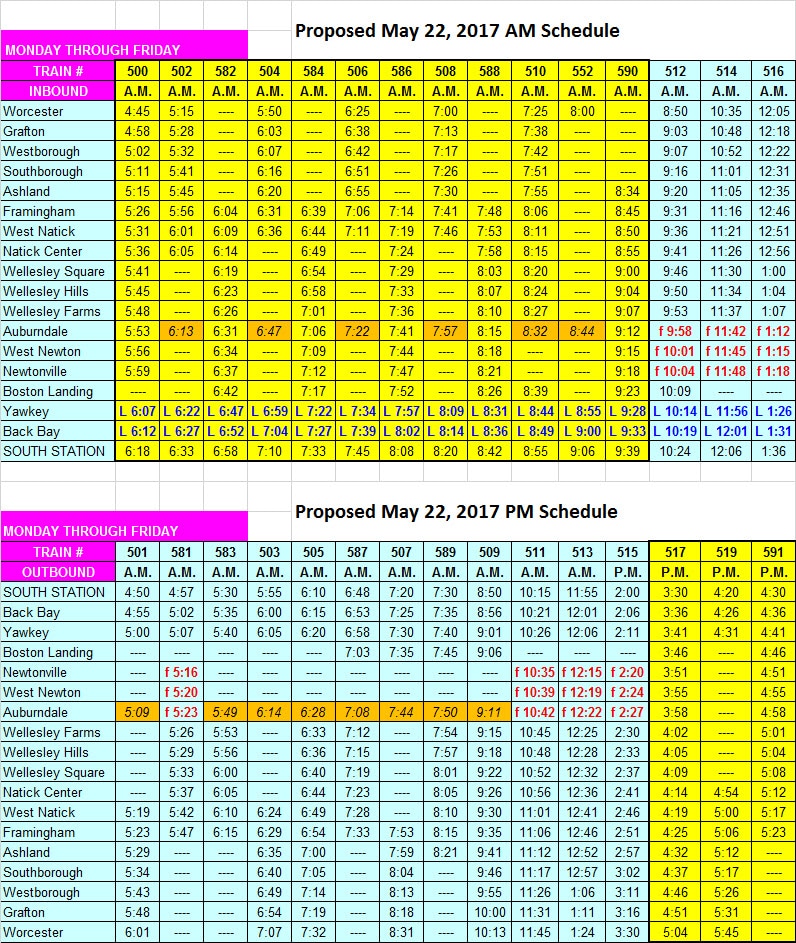
Let's focus on the AM commute to see how disastrous the track change could be. First, we'll take a look at how things work on the proposed May 2017 schedule. As discussed above, track 2 is the inbound track and track 1 is the outbound track for the AM commute (actually from Framingham all the way to Boston). Keeping the tracks dedicated to these 'directions' for the AM commute allows for unimpeded flow. I've added the approximate times that EVERY train passes Auburndale to the schedule image below - the orange boxes with italicized times are NOT station stops, but rather the times that a train passes Auburndale without stopping.
The simple problem is that moving trains back and forth from one track to another blocks both tracks for opposing traffic while the switches are aligned for the track change and while the train moves from one track to another. Properly implementing this would require precise timing for trains to meet (or actually NOT meet) at these locations. The current schedule is not designed to accommodate that timing. And with the AM and PM rush hour schedules jam packed with trains, tweaking the times of ANY train will require changing the times for ALL TRAINS. THIS IS WHY THIS ONE STATION DESIGN AFFECTS EVERYONE ON THIS LINE. It's not just a problem for the Auburndale passengers.
I'll dive into the details below and present some potential solutions at the bottom. Skip forward to those if you're not interested in the technical details.
100% Design Now Complete
On February 15, 2017, the MBTA held a public meeting to present the final design for the reconstruction of the Auburndale Commuter Rail Station. I joined about 50 people to listen to the presentation which was led by a combination of the MBTA Capital Delivery Department Project Manager, the Design Consultant Project Manager, and the Project Manager from the architecture firm. Much thanks to the Village Bank in Auburndale for their hospitality and for providing snacks!
About 17 people spoke to provide comments on the station design. Many comments focused on construction issues such as the potential loss of parking and road closures while the station is being rebuilt. Some relevant comments related to the design and final product included:
- Shelter has no walls to provide protection from the wind (multiple comments on this topic);
- Design does not include screening between the station and the Mass Pike; and
- Thanks and praise for the accessibility that the new station will provide.
I used my public comment time to highlight the switching platform problem and the potential schedule and/or service disruption problem.
Ari Ofsevit spoke after me and echoed the concerns about a single platform station on track 1. He picked up on a potential interesting solution to part of the problem - please read his blog post for his summary of the problem and his idea for a solution.
Why design a new station with a platform on one track only?
Since the Mass Pike was constructed along the railroad right-of-way in the 1960's, the three Newton stations have had a platform on the track 2 side only. This is the reason that those stations have no 'reverse peak' service: track 2 is used for inbound AM trains AND outbound PM trains. Similarly, track 1 is used for outbound AM trains and inbound PM trains - and without a platform on track 1 at any of those stations, none of those trains can stop there.
The concept of a redesign of the Auburndale station has been ongoing for many years - driven by the local community and local politicians. The major goal of the redesign appears to have been to provide an accessible station - but both a handicapped accessible station AND a more accessible station to the village center and the surrounding community.
Maintaining a one platform station (rather than constructing platforms on both sides of the station) is apparently a strategy that was adopted to minimize the cost of the project. It is important to note that the Americans with Disabilities Act essentially mandates that when any improvements or changes are made to a Commuter Rail station that exceed 30% of the assessed value of the station, all elements of the station must be made fully ADA-accessible. These accessibility requirements require full length high level platforms and the 'typical' accessibility elements that we are familiar with at newer stations like Yawkey and Boston Landing. This means that it is not legal nor acceptable to build a new platform on track 1 and keep the low level existing platform on track 2.
In 2013, a 30% design review meeting was held for the Auburndale station where a single rebuilt platform on track 2 was presented (at least as one of the options). This design required passengers to go "up and over" both tracks to get from the village center to the platform. According to reports, this design was widely criticized at that public meeting and the public advocated or agreed that having the station platform on track 1 was the correct option - where the "up and over" is not needed. There does not appear to have ever been a concept or plan to design or build a two-platform solution, nor did the project team convey the operational issues with a platform on the track 1 side only.
In my opinion, NO COMMUTER RAIL STATION on a two track line should ever be allowed to have a one platform station designed, constructed, or even talked about. Commuter Rail stations don't get built very often, and having a station with a platform on only one track potentially locks that station into reduced service for many years.
The current design for the Auburndale station (with the new platform on track 1) includes a new "universal interlocking" just east of the station. This interlocking is a set of switches that allows a train to switch from either track to the other track. The new interlocking ("CP 10") will mean that Auburndale will have interlockings on either side of the station (CP 11 already exists). The intent of adding a new interlocking was to provide a way for trains to switch from track 2 to track 1 to make a station stop at the new platform on track 1. It is apparent that everyone involved assumed that these interlockings and this switching back-and-forth concept would allow for either the same level of service or even better service. BUT THERE WAS NO MODELING OF THE SCHEDULE TO PROVE THAT.
During the public meeting, I described the problem as this: even with two interlockings on either side of the station, there are still essentially two one-way streets pointed at each other. Switching trains back and forth will require precise timing and probably will require some trains pausing to allow these switching moves to happen. This is less than ideal - well, actually, it's disastrous.
What does switching the platform from track 2 to track 1 do to the schedule?
Let's focus on the AM commute to see how disastrous the track change could be. First, we'll take a look at how things work on the proposed May 2017 schedule. As discussed above, track 2 is the inbound track and track 1 is the outbound track for the AM commute (actually from Framingham all the way to Boston). Keeping the tracks dedicated to these 'directions' for the AM commute allows for unimpeded flow. I've added the approximate times that EVERY train passes Auburndale to the schedule image below - the orange boxes with italicized times are NOT station stops, but rather the times that a train passes Auburndale without stopping.
If we focus on the Auburndale station stop times and rotate the data, we get the table below.
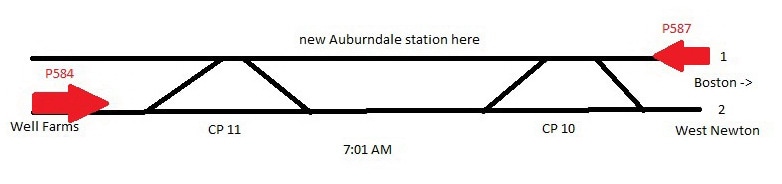
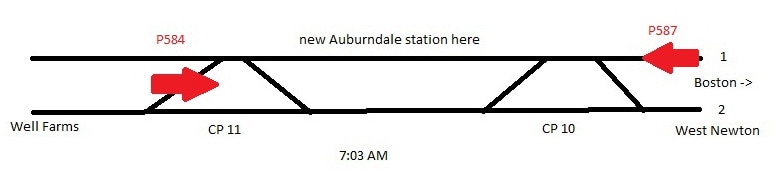
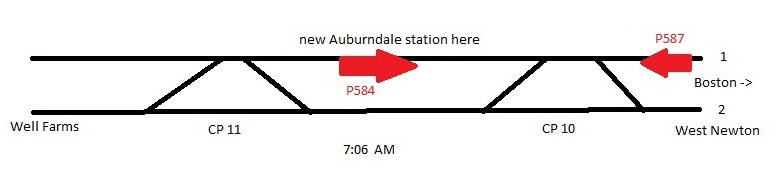
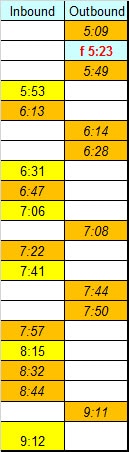 | It is clear that there are multiple moments that trains are passing each other near Auburndale. From about 6 AM to about 8 AM, there are 5 train pairs where an inbound and outbound train pass at Auburndale within seven minutes of each other. That's TEN TRAINS affected. To take a closer look at the schedule implications, we'll assume that we will maintain the same service as the current schedule with Auburndale continuing to have 'normal' rush hour service: inbound AM trains and outbound PM trains stopping there (and no reverse peak service). In the morning, this requires inbound trains to switch from track 2 to track 1 at CP 11 after Wellesley Farms and then back to track 2 at new CP 10 after Auburndale. The problem is that with opposing movements on the same track, one train has to stop at (or not get to) each interlocking until the other train is completely clear of that track and switched onto the other track at the interlocking. If the sections of track were long enough and train density low enough, the schedule could be timed to allow this meet to happen unimpeded - each train could occupy the interlocking while the other train is still underway towards the interlocking. Can that work for us? Let's look at the times and how this switching can be done. We'll start with the P587 / P584 conflict as a test case for how this would happen on the proposed May 2017 schedule. P584 is scheduled to stop at Auburndale at 7:06 AM and P587 is moving as an express outbound and should be near Auburndale at 7:08 AM. Here's the timeline, with some horribly crude not-to-scale track diagrams. |
7:01 AM:
Track 1 in Boston: P587 moving westbound, approaching Boston Landing
Track 2 near Wellesley Farms: P584 departing the station stop.
Track 1 in Boston: P587 moving westbound, approaching Boston Landing
Track 2 near Wellesley Farms: P584 departing the station stop.
7:03 AM:
Track 1 at Boston Landing: P587 departing the station stop.
Track 2 at CP 11: P584 passing inbound through CP 11 and switching to track 1.
Track 1 at Boston Landing: P587 departing the station stop.
Track 2 at CP 11: P584 passing inbound through CP 11 and switching to track 1.
7:06 AM:
Track 1 at Auburndale: P584 making the station stop.
Track 1 near West Newton: P587 approaching CP 10.
Track 1 at Auburndale: P584 making the station stop.
Track 1 near West Newton: P587 approaching CP 10.
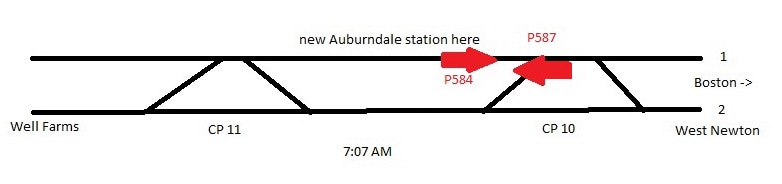
7:07 AM:
Track 1 at CP 10: P584 stopped inbound at CP 10 awaiting P587.
Track 1 at CP 10: P587 switching from track 1 to track 2.
Track 1 at CP 10: P584 stopped inbound at CP 10 awaiting P587.
Track 1 at CP 10: P587 switching from track 1 to track 2.
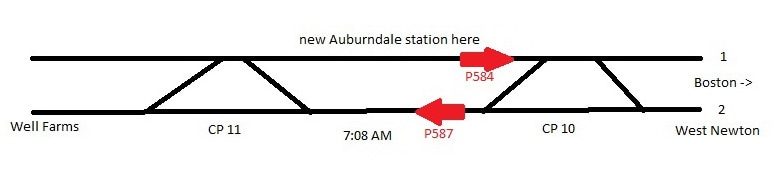
7:08 AM:
Track 1 at CP 10: P584 stopped while switches are realigned to allow it to switch to track 2.
Track 2 at Auburndable: P587 passing P584 and moving outbound on track 2.
Track 1 at CP 10: P584 stopped while switches are realigned to allow it to switch to track 2.
Track 2 at Auburndable: P587 passing P584 and moving outbound on track 2.
7:09 AM:
Track 1 at CP 10: P584 moving inbound from track 1 to track 2 towards the station stops at West Newton
Track 2 at CP 11: P587 moving outbound from track 2 back to track 1.
Track 1 at CP 10: P584 moving inbound from track 1 to track 2 towards the station stops at West Newton
Track 2 at CP 11: P587 moving outbound from track 2 back to track 1.
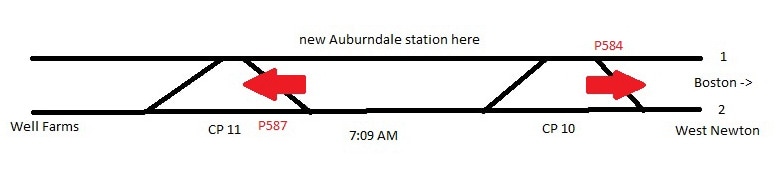
This scenario has taken less than 10 minutes but it involves about 8 miles of track along with each train passing through FOUR switches - two at each interlocking. Obviously that's less than ideal - and it doesn't even work (one train needed to wait at a signal / interlocking). And we've only tried to solve ONE of the conflicts.
Part of the problem is the one mile length of the "wrong direction" track at Auburndale. For these scenarios to work, it is almost impossible to get the timing exact so that the trains are both on the 'wrong' track at the same time - in other words, having the inbound train moving through CP 11 from track 2 to 1 and the outbound train moving from track 1 to 2 at CP 10 AT EXACTLY THE SAME MOMENT. If either of those movements doesn't happen at the same time, then it is likely one train will get through their set of switches but will arrive at the next interlocking before the other train has cleared through it. With only ONE mile between interlockings, there just isn't enough time for anything to go less than perfectly. The first train will have to stop at the 'blocked' interlocking and wait for the other train to clear the interlocking.
This can be illustrated by attempting to fix the CP 10 conflict in our model scenario above by moving the operation of P587 five minutes earlier. But this just moves the conflict to CP 11! P587 will arrive at CP 11 before P584 has had time to switch from track 2 to track 1 at CP 11.
This analysis proves that to have trains pass each other at Auburndale on the 'wrong' tracks requires precisely timed meets that would have to occur with the precision measured in seconds. Any delay of even a few minutes to one of the trains involved in the meet would most likely delay the other train. Most of you realize that keeping trains on time to the precision of under a minute is not a realistic goal on this line.
With this short distance between interlockings, the clear solution is to move one train completely through BOTH interlockings before the other train arrives. Then the timing does not have to be as precise, since the second train just needs to arrive after the first train has cleared both interlockings. But wait a minute...by doing that, THE RAILROAD IS EFFECTIVELY REDUCED TO A SINGLE TRACK AT THAT LOCATION! We've been waiting years for them to fix the single track bottleneck at Beacon Park, and now we're implementing a new one. That's one context to prove this won't work. Also remember that the new CP 10 interlocking can't be moved east to make the single track section longer - the West Newton platform is still on track 2 just east of new CP 10. Ugh.
But even if you accept the concept of an effective single track at Auburndale solution, the schedule consequences are massive. P587 would have to move 10-15 minutes earlier so that it could get past CP 11 before P584 arrived there... but once you start making changes that dramatic, the schedule completely falls apart for multiple different reasons:
1) Meets at Framingham (departure/arrival of local trains vs. expresses);
2) Arrival times of trains at Boston; and
3) The equipment cycle.
The equipment cycle problem is easy to illustrate since it isn't even possible to move P587 five minutes (let alone 10-15 minutes) earlier - it is using the equipment from P502 which arrives at South Station at 7:33 AM. With 15 minutes as the most reliable time to turn a train from inbound to outbound at South Station, moving the departure time of P587 from 7:48 AM to 7:43 AM would require moving P502 five minutes earlier... and you can see how the problems cascade exponentially (especially if you start moving departure times by 10 or 15 minutes). In fact, the AM schedule is completely jam packed at both Framingham and in Boston - so there isn't any way to tweak the times of any train without AFFECTING EVERY OTHER TRAIN FROM 6 AM TO 9 AM.
THIS IS WHY THIS ONE STATION DESIGN AFFECTS EVERYONE ON THIS LINE. It's not just a problem for Auburndale passengers.
But wait, it gets worse. The signal system of a railroad is designed to prevent collisions, and it does this by essentially warning a train crew about the condition of the rail and signals ahead. For example, when you're driving around town in your 2 ton car, you can see any traffic signal with plenty of time to stop. On a higher speed highway, there might be a warning sign that a traffic signal is ahead - and sometimes those even warn you of the CONDITION of the signal (i.e. signs which say "red signal ahead when flashing"). For a multi-ton train that isn't as easy to stop, this is exactly how the railroad signal system works. If a signal is red for stop, then signals BEFORE that red signal will require the train to start slowing down well before it reaches the red signal.
The implications of this for the CP 11 - CP 10 dance are clear. If our inbound P584 is switching from track 2 to track 1 to make the station stop at Auburndale, it is effectively occupying BOTH tracks in that area, and there will be stop signals facing an outbound train coming from Boston. The 'warning' signals that require the outbound P587 to slow down approaching the stop signals will stretch towards Boston for at least a few miles. This means that P587 is either going to have to slow down as it approaches the area (with the resultant negative schedule consequences) or the schedule will have to be adjusted to keep it away from that entire area until the signals can allow for the train to operate at normal full speed. Either way, the overall schedule is drastically affected. And remember - the schedule of an AM outbound train is critical for inbound service - those outbound trains have to get out to Worcester or Framingham in order to operate back inbound.
So what's the solution for this mess? There are a number of possibilities:
1) Build Auburndale with a platform on both tracks. This should be the ONLY solution. It allows for flexible scheduling with increased service for the reverse commute option. But it isn't funded and it isn't designed. Your first reaction might be that a two platform station would be much more expensive than the current plan, but that's not the case. The two-platform Yawkey station cost ~$13.5 million and the two-platform South Acton station recently cost ~$9.5 million. The average of those is $11.5 million - which is the amount budgeted / estimated for the current Auburndale design. We're getting a one platform station for about the same cost as a two platform station - because we're also getting a new interlocking and signal system upgrades (which don't really help us).
There are two sub-options under this solution:
a) Postpone implementation of the current design until a two platform solution can be designed, funded, and implemented. Obviously this delays accessibility for Auburndale station.
b) Modify the current design to incorporate elements that will allow for a two platform station in the future. For example, set aside space that can accommodate elevators, ramps, and other required elements to get across the tracks - even if they can't be built now.
2) Implement Ari's solution detailed in his blog - build new platforms on track 1 at all three Newton stations using the money budgeted for the new CP 10 interlocking (which Ari readily admits is inferior to building a two-platform station at Auburndale). This would presumably allow all three Newton stations to have the same rush-hour only service that they have now. It still may require some schedule changes, because Wellesley Hills and West Natick require rush hour service on track 2 only (see this blog post about that). So rush hour trains would still be required to switch tracks at CP 11. But it would be easier to manage ONE change of tracks rather than two for rush hour trains. Also note that this solution perpetuates the lack of reverse commute service throughout Newton. And with millions of dollars being spent on stations in Newton now, the second platform at each station will probably be delayed well into the distant future.
3) Build the station as designed and change the use of Auburndale. This concept eliminates rush hour 'normal' commute service at Auburndale but implements NEW 'reverse' commute service at Auburndale. In other words, since the 'reverse' commute trains are already using track 1, having them stop at the new Auburndale platform will not introduce the switching tracks CP 11 - CP 10 dance problem. Keep the trains traveling on the tracks they use today. Obviously the downside to this is the loss of the brand new Auburndale station to the ridership that uses the station the most - passengers commuting to and from Boston on a 'typical' schedule. And although the data is somewhat old, the indications are that Auburndale is the busiest of the three stations. This solution also means that the new CP 10 will be relatively unused (although more interlockings on a railroad are generally good, since they offer solutions to unforeseen problems).
4) Demand the MBTA develop a functional schedule AND solicit public input BEFORE construction proceeds. This should have been how the project started - isn't the schedule the most important aspect of a station? What does accessibility matter if the station has no service? Regardless of how we got to where we are now, this solution should be implemented in conjunction with any solution above or any other possible solution. Who knows, maybe they can come up with something that works... but I seriously doubt it.
I will be raising this issue in future meetings of the Worcester Working Group and I'll engage with local politicians and stakeholders. It's never too early to reach out to your legislators to sound off on this issue. I'll keep you updated with what I learn.
Part of the problem is the one mile length of the "wrong direction" track at Auburndale. For these scenarios to work, it is almost impossible to get the timing exact so that the trains are both on the 'wrong' track at the same time - in other words, having the inbound train moving through CP 11 from track 2 to 1 and the outbound train moving from track 1 to 2 at CP 10 AT EXACTLY THE SAME MOMENT. If either of those movements doesn't happen at the same time, then it is likely one train will get through their set of switches but will arrive at the next interlocking before the other train has cleared through it. With only ONE mile between interlockings, there just isn't enough time for anything to go less than perfectly. The first train will have to stop at the 'blocked' interlocking and wait for the other train to clear the interlocking.
This can be illustrated by attempting to fix the CP 10 conflict in our model scenario above by moving the operation of P587 five minutes earlier. But this just moves the conflict to CP 11! P587 will arrive at CP 11 before P584 has had time to switch from track 2 to track 1 at CP 11.
This analysis proves that to have trains pass each other at Auburndale on the 'wrong' tracks requires precisely timed meets that would have to occur with the precision measured in seconds. Any delay of even a few minutes to one of the trains involved in the meet would most likely delay the other train. Most of you realize that keeping trains on time to the precision of under a minute is not a realistic goal on this line.
With this short distance between interlockings, the clear solution is to move one train completely through BOTH interlockings before the other train arrives. Then the timing does not have to be as precise, since the second train just needs to arrive after the first train has cleared both interlockings. But wait a minute...by doing that, THE RAILROAD IS EFFECTIVELY REDUCED TO A SINGLE TRACK AT THAT LOCATION! We've been waiting years for them to fix the single track bottleneck at Beacon Park, and now we're implementing a new one. That's one context to prove this won't work. Also remember that the new CP 10 interlocking can't be moved east to make the single track section longer - the West Newton platform is still on track 2 just east of new CP 10. Ugh.
But even if you accept the concept of an effective single track at Auburndale solution, the schedule consequences are massive. P587 would have to move 10-15 minutes earlier so that it could get past CP 11 before P584 arrived there... but once you start making changes that dramatic, the schedule completely falls apart for multiple different reasons:
1) Meets at Framingham (departure/arrival of local trains vs. expresses);
2) Arrival times of trains at Boston; and
3) The equipment cycle.
The equipment cycle problem is easy to illustrate since it isn't even possible to move P587 five minutes (let alone 10-15 minutes) earlier - it is using the equipment from P502 which arrives at South Station at 7:33 AM. With 15 minutes as the most reliable time to turn a train from inbound to outbound at South Station, moving the departure time of P587 from 7:48 AM to 7:43 AM would require moving P502 five minutes earlier... and you can see how the problems cascade exponentially (especially if you start moving departure times by 10 or 15 minutes). In fact, the AM schedule is completely jam packed at both Framingham and in Boston - so there isn't any way to tweak the times of any train without AFFECTING EVERY OTHER TRAIN FROM 6 AM TO 9 AM.
THIS IS WHY THIS ONE STATION DESIGN AFFECTS EVERYONE ON THIS LINE. It's not just a problem for Auburndale passengers.
But wait, it gets worse. The signal system of a railroad is designed to prevent collisions, and it does this by essentially warning a train crew about the condition of the rail and signals ahead. For example, when you're driving around town in your 2 ton car, you can see any traffic signal with plenty of time to stop. On a higher speed highway, there might be a warning sign that a traffic signal is ahead - and sometimes those even warn you of the CONDITION of the signal (i.e. signs which say "red signal ahead when flashing"). For a multi-ton train that isn't as easy to stop, this is exactly how the railroad signal system works. If a signal is red for stop, then signals BEFORE that red signal will require the train to start slowing down well before it reaches the red signal.
The implications of this for the CP 11 - CP 10 dance are clear. If our inbound P584 is switching from track 2 to track 1 to make the station stop at Auburndale, it is effectively occupying BOTH tracks in that area, and there will be stop signals facing an outbound train coming from Boston. The 'warning' signals that require the outbound P587 to slow down approaching the stop signals will stretch towards Boston for at least a few miles. This means that P587 is either going to have to slow down as it approaches the area (with the resultant negative schedule consequences) or the schedule will have to be adjusted to keep it away from that entire area until the signals can allow for the train to operate at normal full speed. Either way, the overall schedule is drastically affected. And remember - the schedule of an AM outbound train is critical for inbound service - those outbound trains have to get out to Worcester or Framingham in order to operate back inbound.
So what's the solution for this mess? There are a number of possibilities:
1) Build Auburndale with a platform on both tracks. This should be the ONLY solution. It allows for flexible scheduling with increased service for the reverse commute option. But it isn't funded and it isn't designed. Your first reaction might be that a two platform station would be much more expensive than the current plan, but that's not the case. The two-platform Yawkey station cost ~$13.5 million and the two-platform South Acton station recently cost ~$9.5 million. The average of those is $11.5 million - which is the amount budgeted / estimated for the current Auburndale design. We're getting a one platform station for about the same cost as a two platform station - because we're also getting a new interlocking and signal system upgrades (which don't really help us).
There are two sub-options under this solution:
a) Postpone implementation of the current design until a two platform solution can be designed, funded, and implemented. Obviously this delays accessibility for Auburndale station.
b) Modify the current design to incorporate elements that will allow for a two platform station in the future. For example, set aside space that can accommodate elevators, ramps, and other required elements to get across the tracks - even if they can't be built now.
2) Implement Ari's solution detailed in his blog - build new platforms on track 1 at all three Newton stations using the money budgeted for the new CP 10 interlocking (which Ari readily admits is inferior to building a two-platform station at Auburndale). This would presumably allow all three Newton stations to have the same rush-hour only service that they have now. It still may require some schedule changes, because Wellesley Hills and West Natick require rush hour service on track 2 only (see this blog post about that). So rush hour trains would still be required to switch tracks at CP 11. But it would be easier to manage ONE change of tracks rather than two for rush hour trains. Also note that this solution perpetuates the lack of reverse commute service throughout Newton. And with millions of dollars being spent on stations in Newton now, the second platform at each station will probably be delayed well into the distant future.
3) Build the station as designed and change the use of Auburndale. This concept eliminates rush hour 'normal' commute service at Auburndale but implements NEW 'reverse' commute service at Auburndale. In other words, since the 'reverse' commute trains are already using track 1, having them stop at the new Auburndale platform will not introduce the switching tracks CP 11 - CP 10 dance problem. Keep the trains traveling on the tracks they use today. Obviously the downside to this is the loss of the brand new Auburndale station to the ridership that uses the station the most - passengers commuting to and from Boston on a 'typical' schedule. And although the data is somewhat old, the indications are that Auburndale is the busiest of the three stations. This solution also means that the new CP 10 will be relatively unused (although more interlockings on a railroad are generally good, since they offer solutions to unforeseen problems).
4) Demand the MBTA develop a functional schedule AND solicit public input BEFORE construction proceeds. This should have been how the project started - isn't the schedule the most important aspect of a station? What does accessibility matter if the station has no service? Regardless of how we got to where we are now, this solution should be implemented in conjunction with any solution above or any other possible solution. Who knows, maybe they can come up with something that works... but I seriously doubt it.
I will be raising this issue in future meetings of the Worcester Working Group and I'll engage with local politicians and stakeholders. It's never too early to reach out to your legislators to sound off on this issue. I'll keep you updated with what I learn.
 RSS Feed
